The Bee Gym
The Bee Gym is a grooming station for honey bees, intended to assist the bees in ridding themselves of the varroa parasite.
Read More
A garden apiary in Whittlesford, Cambridge, UK - honey bees and their beekeeper Hilary van der Hoff.
The Bee Gym is a grooming station for honey bees, intended to assist the bees in ridding themselves of the varroa parasite.
Read MoreBees' feet are more complicated than our own. A lot of engineering goes into them, to allow the bees to walk on different surfaces. Most bees I know can walk up glass, whereas most people I know can't. Jonathan Pattrick is a local student doing his PhD thesis on how flower petals and bees' feet interact, and he gave an evening talk to the CBKA on this subject.
See those tarsal claws, like grappling hooks at the tip of each leg? Those, Jonathan explained, are for walking on rough surfaces. Each foot has two claws, hooking outward. Between the claws is an adhesive pad. This secretes a liquid so that the foot can stick to a smooth surface by surface tension. The foot is unfoldable to expose the pad. So to walk on a rough surface, the bee uses its claws. To walk on a smooth surface, the bee unfolds its feet and uses the sticky pads, placing each pad down and then peeling it off in exactly the right way to detatch it.
Jonathan showed video footage from a light microscope positioned under a slide, looking up as the bee walked over the slide. You could see the footpads spreading over the glass to stick down and then peeling off again. The pads are BIG. The whole foot unfolds.
Apparently these unfoldable adhesive pads are found in ants and wasps as well as bees, but each species has its own version. And while honey bees have big sticky pads, those of bumble bees are much smaller. Which means, in practice, a honey bee can walk up a hollyhock flower (very smooth) whereas a bumble bee cannot - the bumble bee has to fly in for a direct landing on the anthers.
Debate ensued as to how flowers might be manipulating insects by having rough or smooth petals to pick and choose their pollinators - is the hollyhock strategically directing bumble bees to touchdown right on the pollen-covered anthers? Do other flowers "deliberately" have rough surfaces so that their chosen pollinators can easily walk in? What does that mean for crop breeding programmes? Hopefully Jonathan will return to tell us more when he has completed his thesis.
Meanwhile, I took this photograph of an ichneumon wasp on the window at home. Feet in action!
I have redesigned the back garden. Gone are the raised beds, the plants that were in them, and the intervening paths. This is what it looks like now:
Copper Hive and Pond Hive now visible from here, having been previously hidden behind raspberry canes.
I sowed many packets of wildflower seeds on the cleared ground, and watered them in. Watch this space!
A jar of honey is scant compensation for being terrorised while pruning the roses.
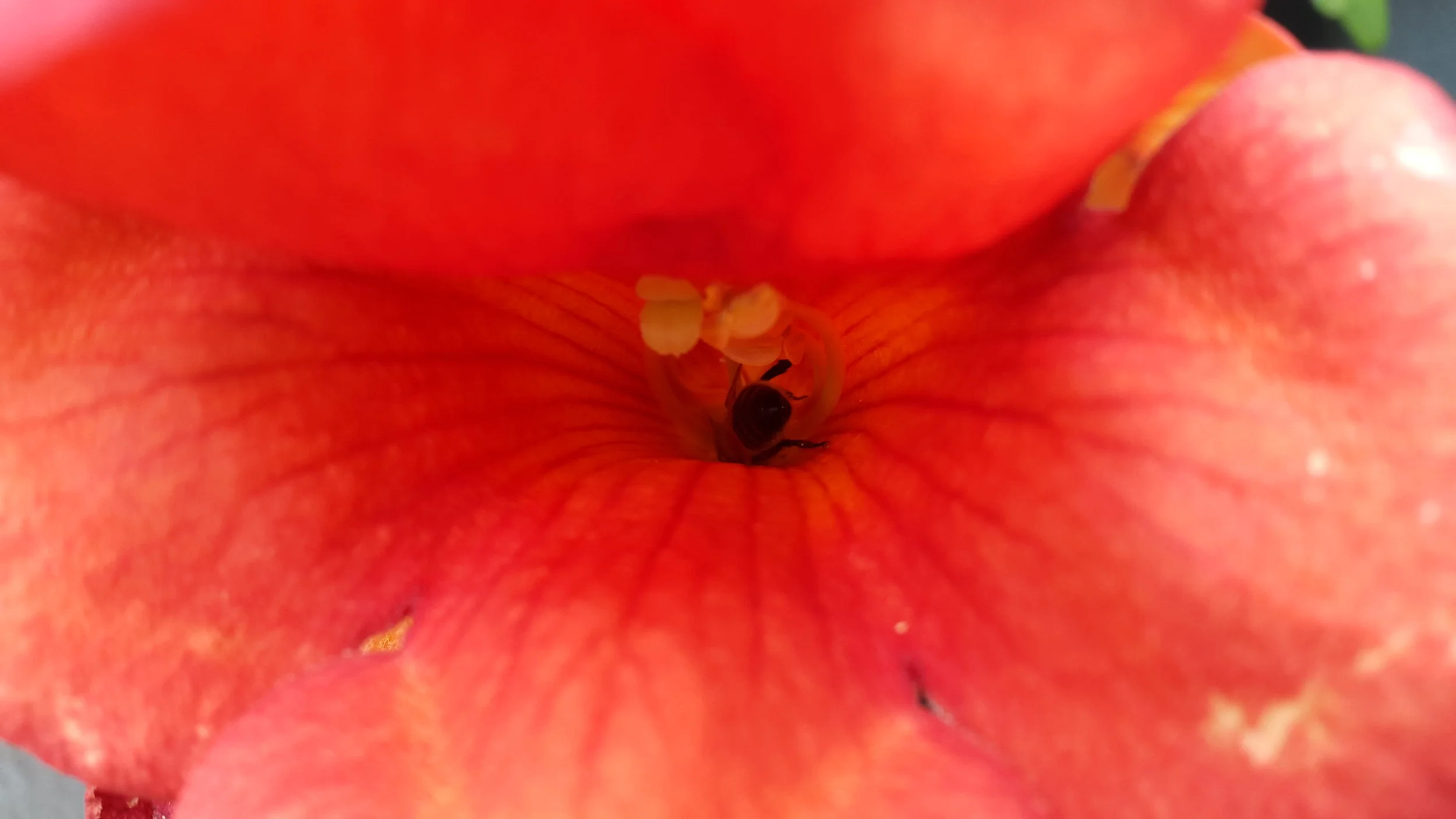
Read MoreIn October, the showiest thing in the garden is the orange trumpet plant that climbs over the top of the fence from next door. The bees love it.
A quick internet search tells me that this is Campsis radicans, the trumpet vine.
The flowers are big and bright, and they seem to be a source of both nectar and pollen. Some bees head right down into the narrow funnel of the trumpet, where there may be nectar. Others are gathering pollen from the yellow anthers further up.
But somebody else is foraging here too. This spider has captured one of the bees in a strategically located web!
Upper entrances for beehives!
Read More