Queen Felicity
I hope I never become blasé about seeing Queens
Read More
A garden apiary in Whittlesford, Cambridge, UK - honey bees and their beekeeper Hilary van der Hoff.
I hope I never become blasé about seeing Queens
Read MoreAs pictured here, you can see that the garden is a mess, but we enjoy a nice Sunday breakfast watching the bees.
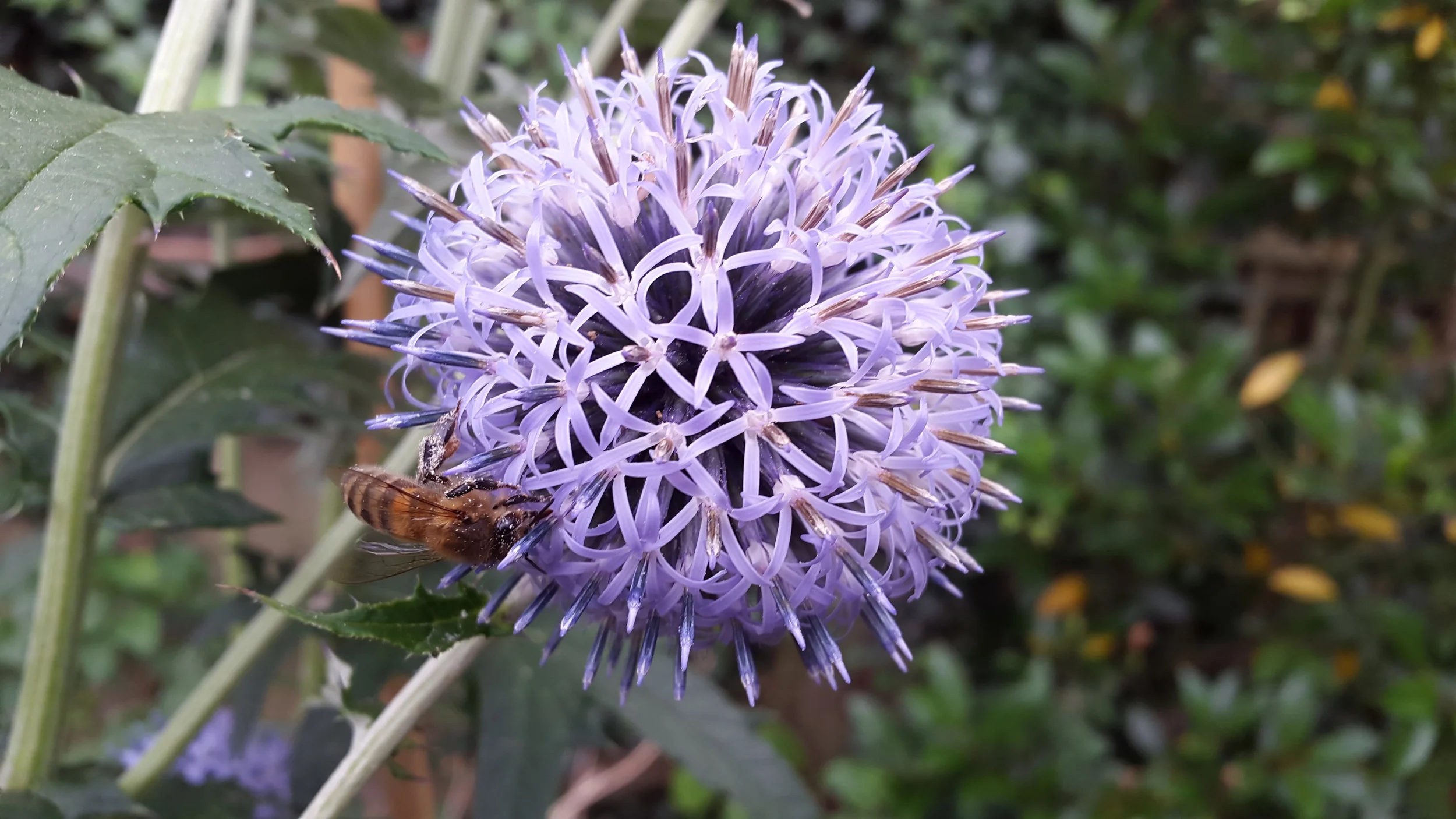
It is late Summer and the availability of forage in the garden (for the bees at least) is reducing, but there are still some flowers around. The bees' favourite thing is the Echinops:
And they continue to forage on the remaining raspberry flowers, but most of those are now turning to fruit:
The bees are on watermint:
And on marjoram:
This forager was collecting pollen from a Japanese anemone. Look at that nice full pollen basket:
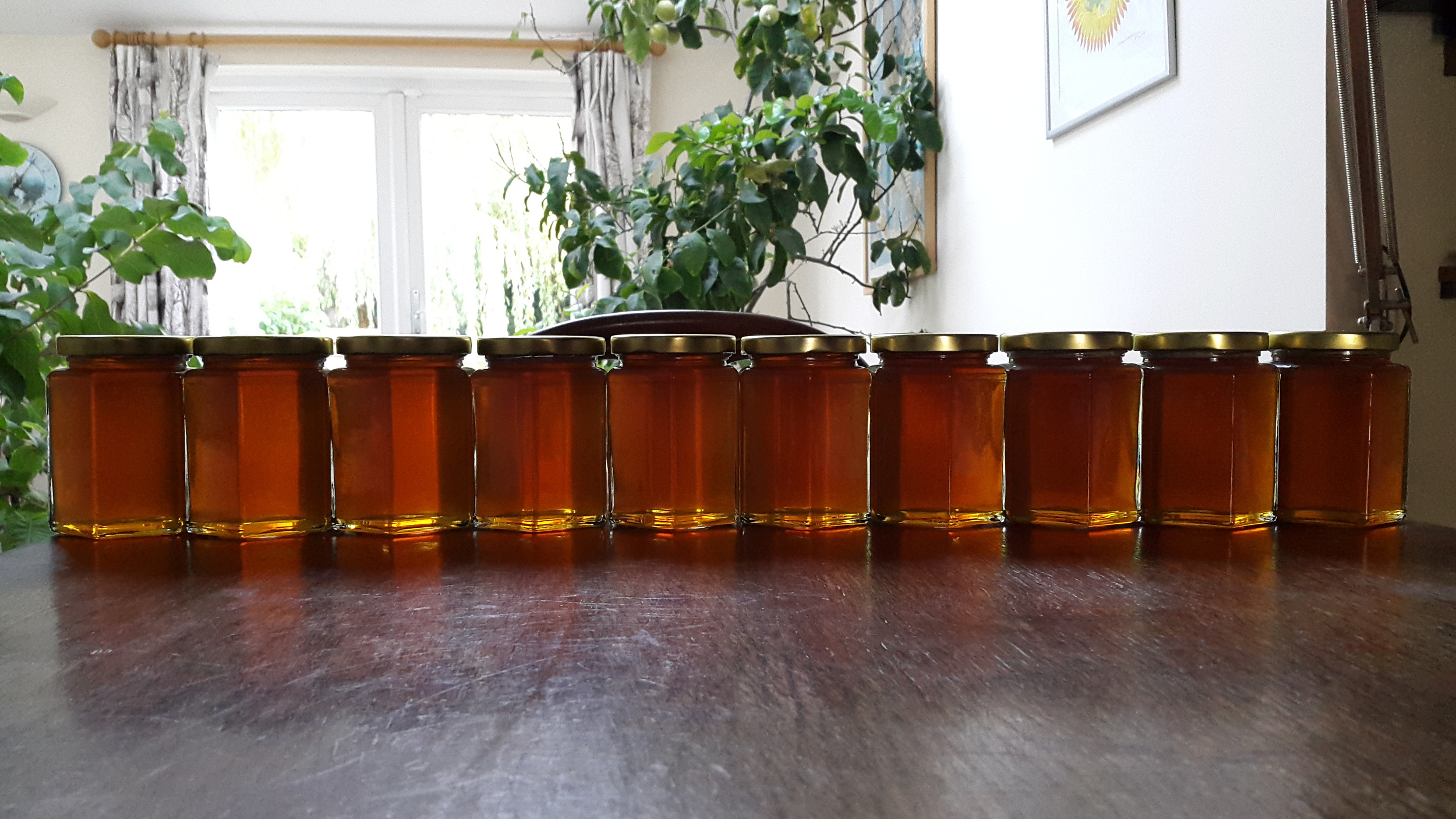
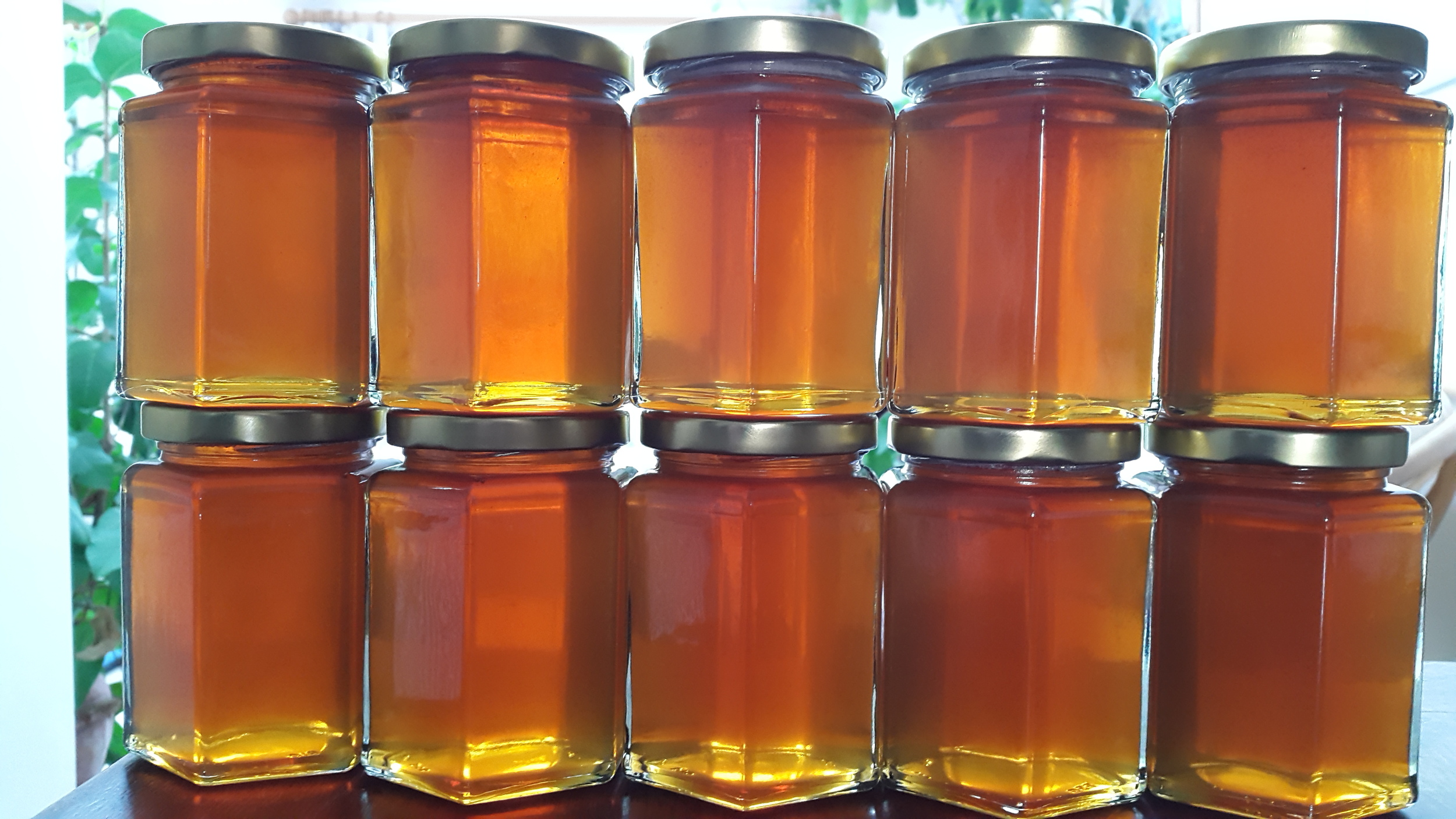
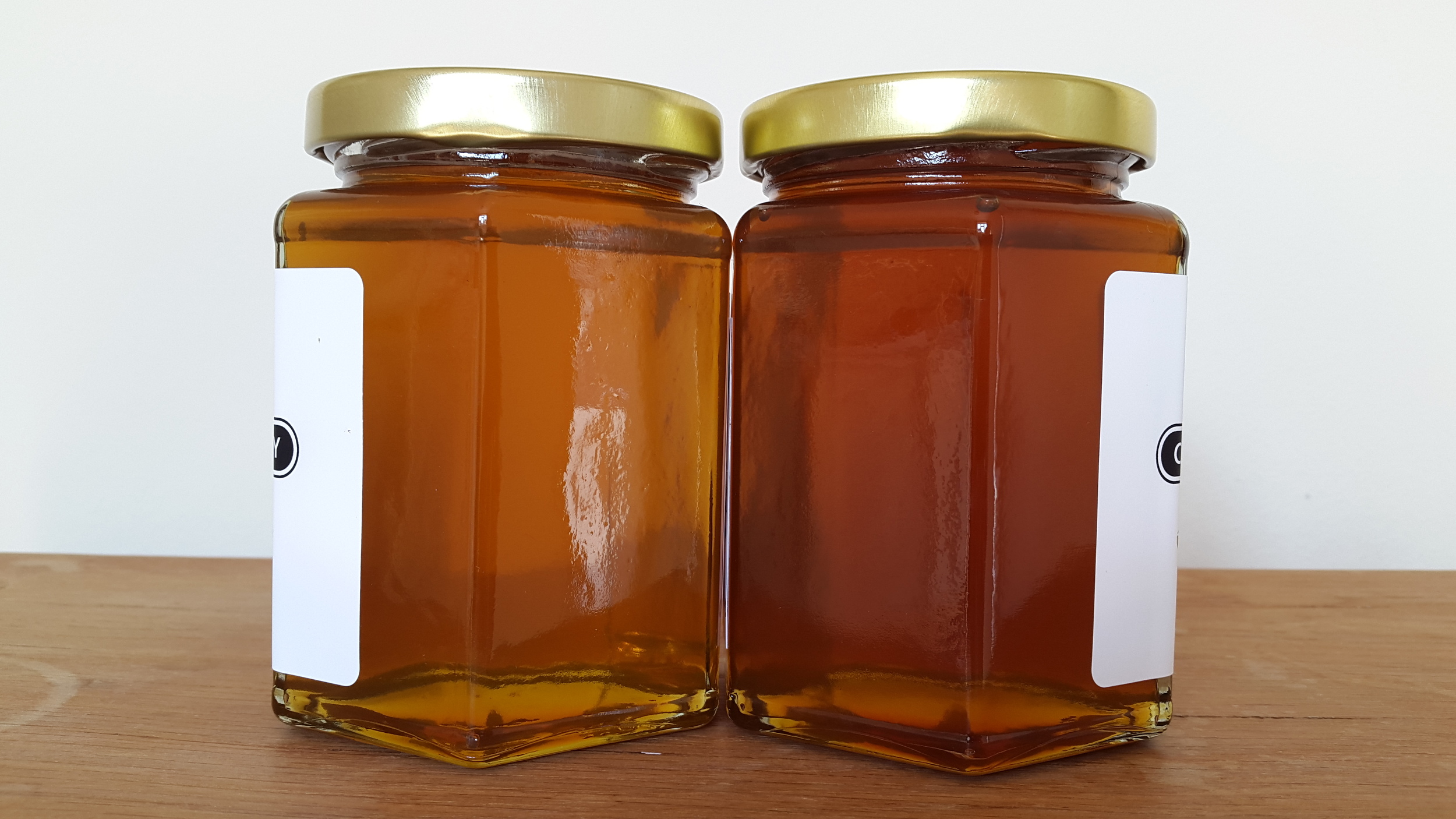
The Smith bees made this honey during the second half of July and the beginning of August. It's different from the earlier honey. Similarly runny, but darker, and with a rounded silky taste. Imagine olive oil and chocolate.
There were swathes of thistles flowering on Stourbridge Common at the time this honey was being made, so I think there must be a good proportion of thistle honey in here.
We extracted 4 frames, which filled 10 jars. The other frames were not fully capped, and have been returned to the bees.
lot#13082016
There are a lot of confused bees flying around the gin terrace looking for their hive, which isn't where they left it.
The Smith beehive has served us well, but it has a design flaw - there is too much surface contact between some of the parts, which increases the risk of crushing bees between moving parts and prompts the bees to apply large amounts of propolis to seal the surfaces together. I'm taking the Smith Hive out of service, and will keep it in reserve as a spare.
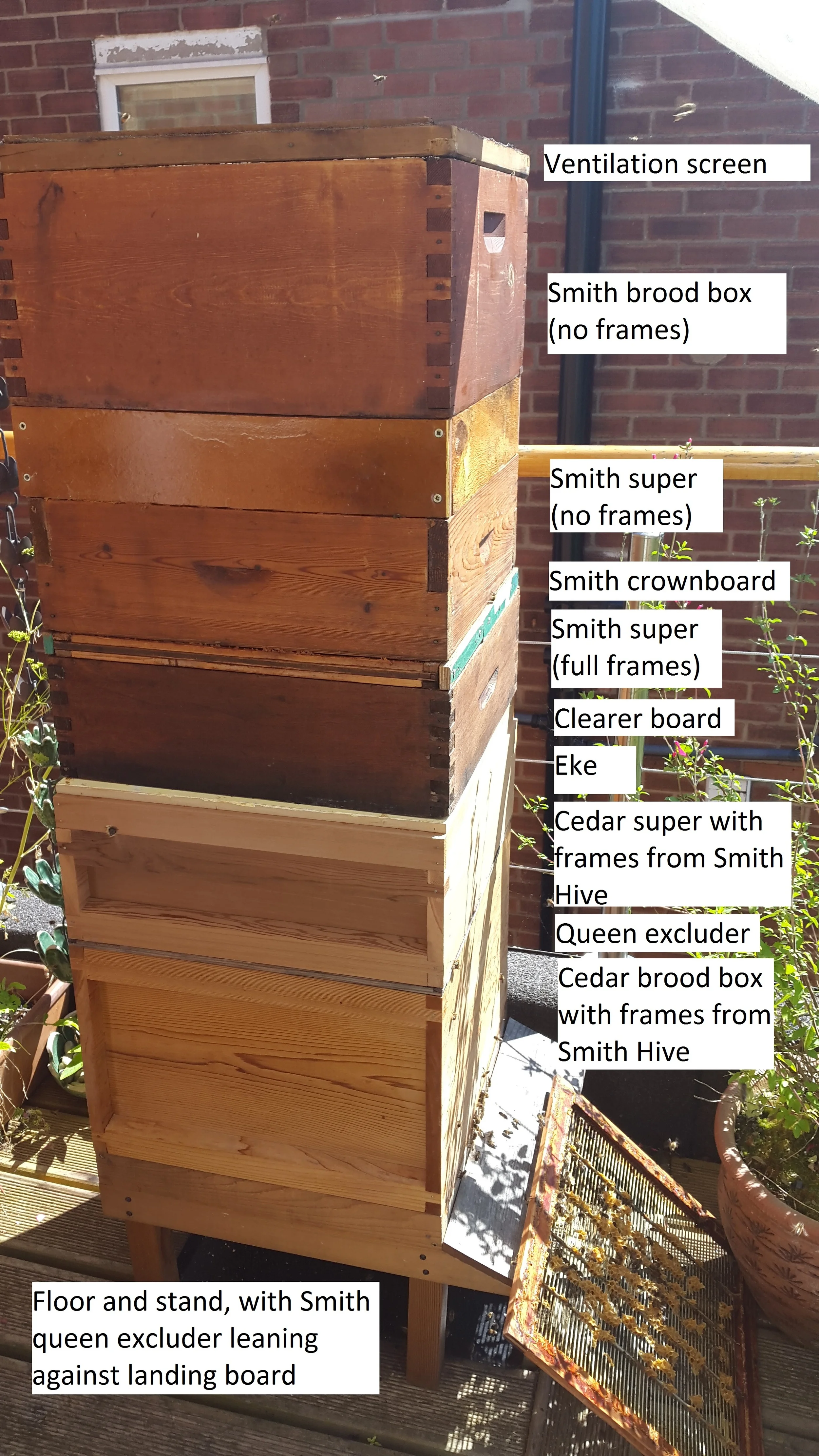
So today I moved the Smith colony to the (previously empty) Cedar Hive, in an adjacent position. In fact it's not quite the full Cedar Hive yet, but the bottom of the Cedar Hive combined with the top of the Smith Hive, like this:
The idea is this:
Flying bees are oriented to the previous location of the Smith Hive, which isn't there any more. It's not far away, but nor is the Disc Hive:
I expect the flying bees to redistribute between the Cedar Hive and the Disc Hive. This will boost the numbers of the small colony in the Disc Hive...it may help that colony, at least I hope it will not harm them. One worker is Nasonov fanning (emitting a homing signal) at the entrance to the Cedar Hive, while there is no sign of this at the Disc Hive entrance...it may help the ex-Smith flying bees find their own colony.
Was the move a stingless operation? Not quite. In lifting the Smith brood box off its floor I trapped a bee between the inside of my knee and the outside wall of the brood box. Of course, she stung me.
I don't know yet whether this has been a successful move. I think it has, but there were probably mistakes I made. Hopefully I'll find out in due course what they were. I didn't see Queen Eve, though I didn't check every frame thoroughly, just looked over them briefly when transferring them across. More worrying is that I did not see eggs or young larvae either. I hope it is just a sign that the colony is shrinking rather than that the Queen is no longer in residence. It would be useful if they could fly a flag like Buckingham Palace does.
Regular readers (hello Mums!) will be keen to know the status of the Disc Hive, following the untimely loss of Queen Gretchen.
So here's the news: WE HAVE A QUEEN!
A quick look at the central brood frame told me all I needed to know. There was already a large patch of sealed worker brood on each side of the frame, and unsealed brood too. Hooray! The bees have made things right all by themselves, without (or perhaps despite) me.
May Queen Honey's reign be long and prosperous.
The Smith bees have produced a magnificent crop of honey.
Read More